If you live in Padfield, Hadfield or anywhere else in Glossop, we can quote for garden design; we also cover nearby Stalybridge, Hyde and Ashton-under-Lyne. Every job starts with a free site visit in Glossop, where we measure up, check access and talk through options before sending a written quote.
Garden design from Glossop Landscaping & Driveways is the planting-led side of our landscape design service. We draw up borders, beds, lawns and the structure around them for homeowners in Glossop who want a garden that looks right through the year and does not need a full-time gardener to keep it that way. The service suits new gardens, tired gardens and anyone who has bought a trolley of plants and watched half of them die.
Three styles cover most requests. Flower garden design builds traditional layered borders for long-season colour. Native plant garden design uses species that suit your soil and the surrounding countryside. Drought-tolerant garden design is for sunny, free-draining plots and anyone who wants to stop watering.
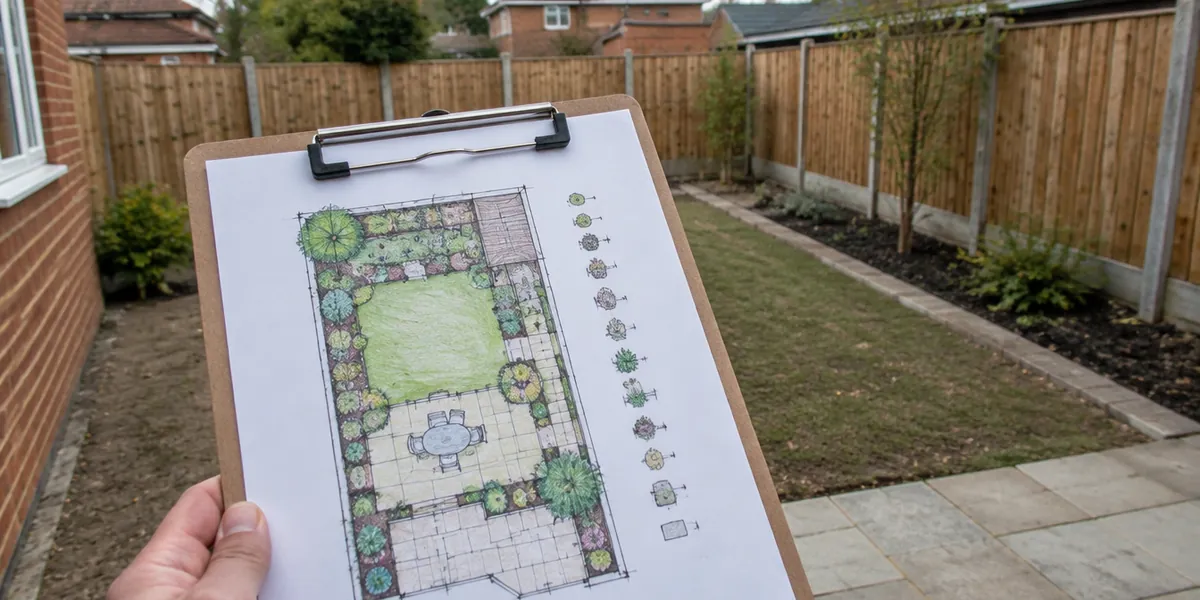
We test the soil, record the aspect and the shade, then specify plants that will live in your conditions, not plants that photograph well. Each design comes with a planting plan marked up with species, pot sizes, quantities and spacing, and a planting calendar. We can plant it for you, and most clients ask us to.
Flower Garden Design
A flower garden design is the classic English border: shrubs for structure, perennials for the main show, bulbs for early colour and a few annuals to fill gaps in the first year. It is the right choice when you want colour from March to October and enjoy a little light work, because borders like this need a tidy in late winter and some deadheading in summer.
We begin by working out which way the border faces and how many hours of sun it gets. A south-facing border in Glossop will take salvias, nepeta and roses; a north-facing one under a fence wants hydrangeas, ferns and hellebores. We lay out the bed at a depth of at least 1.2 metres wherever the plot allows, because a 60 cm border never gives room for proper layering.
The planting plan is built in layers. Shrubs and small trees go at the back or in the middle of an island bed, perennials in drifts of three, five or seven in front, and bulbs tucked between them to flower before the foliage covers them. Flowering times are mixed so something is always coming into bloom as something else goes over.
Soil preparation makes or breaks a flower border. We dig in well-rotted compost or manure to a spade's depth, add grit to heavy clay, and mulch with 50 mm of bark after planting. The best time to plant a new border in Glossop is October or March, when the ground is moist and the roots can establish before summer.
Native Plant Garden Design
Native plant garden design uses species that grow wild in Britain, chosen to suit your soil and to support the bees, butterflies and birds that depend on them. It is the right choice if you want a garden that belongs in the landscape around Glossop, if you have a wet or poor patch where cultivated plants have struggled, or if wildlife matters more to you than tidy edges.
Native does not mean scruffy. A well-designed native garden has structure from hawthorn, field maple, hazel and guelder rose, a meadow or flowering lawn in the open areas, and woodland-edge planting of foxgloves, red campion and wood anemone in the shade. Ponds, even small ones, do more for wildlife than any other feature, and we design them with a shallow beach edge for frogs and hedgehogs.
We take our lead from what grows in the hedgerows and verges nearest your property. Chalk soils suit scabious, knapweed and wild marjoram; heavier clay suits meadowsweet, purple loosestrife and ragged robin. Soil fertility is often too high for a true meadow, so we may strip turf from the meadow area or sow yellow rattle to weaken the grass.
Native gardens need a different maintenance rhythm: one meadow cut in late summer, hedges trimmed outside the nesting season, leaves left under shrubs. We put this into a simple calendar with the design. Everything comes from nurseries working with native British stock, never from the wild.
Drought-Tolerant Garden Design
Drought-tolerant garden design is for gardens that bake. South or west-facing plots, thin sandy or chalky soils, gravel drive edges and roof terraces all suit it. It is also the right choice for anyone who travels a lot, is tired of watering, or has lived through a hosepipe ban and does not want to lose a border to the next one.
The principle is simple: plants adapted to dry summers, planted into free-draining soil and mulched with gravel rather than compost. Lavender, rosemary, cistus, euphorbia, phlomis, stipa grasses and verbena all cope with weeks without rain once established. Many are evergreen or hold good seedheads, so the garden has structure through winter.
Preparation matters more than the plant list. On heavy clay we dig in sharp grit and sometimes raise the bed slightly so winter wet drains away, because cold wet roots kill more Mediterranean plants than drought does. We plant small, usually 9 cm or 2-litre pots, because small plants root out faster into dry ground. A 50 mm mulch of 10 mm gravel keeps the soil cool and the stems dry.
Watering is needed in the first summer only, deeply and weekly. After that the garden should look after itself. A drought-tolerant garden is one of the lowest-maintenance plantings we design in Glossop, needing little more than a cut-back in spring.
Why Glossop Homeowners Choose Us for Garden Design
We design gardens we are going to plant. That keeps us honest about soil, aspect and what will grow in Glossop. A planting plan from us is written to be planted from, with quantities and spacing, not a mood board of plants that may not be available.
We test your soil before we specify anything. A pH test and a feel of the texture tell us whether you have chalk, clay or loam, and we check drainage by digging a test pit after rain.
Our plans are seasonal. We think about what the border looks like in January, which is when most gardens fail, and build in evergreen structure and winter stems so it is never bare. We also tell you honestly how much work each style will need.
If you want us to install the design, the same team does the preparation, planting and mulching, and the work carries a written guarantee. Our outdoor living space design and landscape planning services sit alongside garden design when a project needs hard landscaping or phasing as well.
Garden Design: Step by Step
- First visit. We walk the garden with you, look at what is there, and talk about colour, style, wildlife and how much time you want to spend on it.
- Survey and soil test. We measure the beds, record sun and shade through the day, test pH and texture, and note existing plants worth keeping.
- Concept. A scaled outline showing bed shapes, lawn, paths and the planting style for each area, with photographs of the key plants.
- Planting plan. The detailed plan with every plant named, numbered and spaced, plus pot sizes and quantities for ordering.
- Quote and planting calendar. A written quote for supply and planting, and a calendar showing when each part goes in.
- Ground preparation and planting. We clear, improve the soil, set out the plants from the plan, plant, water in and mulch.
- Aftercare notes. A short guide to watering, pruning and feeding for the first two years.
For most Glossop gardens the design stage takes a few weeks and planting is booked for the next suitable window, usually autumn or spring. We would rather wait for the right conditions than lose plants to a dry spell.
Garden Design in Glossop: What Changes the Price
The size of the garden and the number of separate planting areas drive the design fee. A single long border is quick to plan; a whole garden with lawn, beds, a meadow and a pond takes several drawings.
Survey work makes a difference too. A flat, rectangular plot in Glossop with clear boundaries is straightforward. A sloping garden with mature trees, unknown drains and a disputed fence line needs more time on site before any design can be drawn.
For the planting itself, the main factors are plant sizes and the state of the soil. Mature specimen shrubs cost many times what a 2-litre pot costs, and rubble-filled ground needs more preparation than a worked bed. A native garden sown from seed is far cheaper per square metre than a dense border of named perennials.
Access affects labour, because everything in a terraced garden comes through the house. We set all of this out as separate lines in the written quote.
Garden Design Across Glossop
We design and plant gardens throughout Glossop. If your plot in Hadfield is chalky and free-draining, a drought-tolerant scheme suits it, while if your ground in Charlesworth or Simmondley is heavier, a traditional flower border with plenty of compost dug in will reward you. In Gamesley we have planted several native gardens, which suit any plot backing onto open land, and if your plot in Padfield is smaller, a single well-designed border earns its keep. We cover all of these from our base in Glossop, along with nearby Stalybridge, Hyde and Ashton-under-Lyne.
Your Questions Answered
Can you design a garden that needs very little maintenance?
Yes. Low maintenance usually means fewer plant types in bigger drifts, shrubs rather than perennials, gravel mulch rather than bare soil, and no lawn edges to trim. A drought-tolerant scheme is the lowest-maintenance style we design in Glossop. We will be honest about the trade-offs, because a garden with no work at all also has little seasonal change.
Will you work with plants I already have?
We would rather keep good plants than replace them. On the first visit we identify what is worth saving, what can be moved and what has had its day. Established shrubs and trees give a new design maturity straight away, and we design the new planting around them.
What is the best time of year to plant a new garden in Glossop?
October and November are ideal for shrubs, trees and most perennials because the soil is still warm and the autumn rain does the watering for you. March and April are the next best. We avoid planting in July and August unless irrigation is in place, and we avoid frozen or waterlogged ground in midwinter.
Do you supply the plants or do I buy them?
Either. Most clients ask us to source and plant everything, because we buy from wholesale nurseries and can check the quality before it arrives. If you prefer to buy your own, the planting plan lists every plant with the pot size and quantity so you can order it accurately.
Can a garden design include a lawn, paths or a patio?
A garden design covers the whole layout, including lawn shapes and the route of paths. Where a project needs a new patio, steps or walls designed in detail, we bring in our outdoor living space design service so the hard and soft landscaping are planned together and built by the same team in Glossop.