We take on tarmac driveway installation right across Glossop and its SK13 and SK14 postcodes, from Charlesworth and Gamesley to Padfield, plus nearby Stalybridge, Hyde and Ashton-under-Lyne. We design each new drive in Glossop to drain properly within the front-garden permeable-surface rules, and help with any dropped kerb application to Derbyshire County Council.
Tarmac is the surface we lay more often than any other in Glossop, and for good reason: it goes down quickly, copes with heavy use, and costs less per square metre than block paving or resin. Glossop Landscaping & Driveways installs hot-rolled and porous tarmac driveways for homeowners across Glossop who need reliable parking for one car or four, on frontages of every shape, without a long wait before they can use it. If you are after a practical, dark, even surface that you can sweep and forget, tarmac driveway installation is probably the right starting point.
There is a difference between the tarmac you see peeling at the edges on some drives and the tarmac that still looks good after many years, and the difference is almost all in the preparation. A proper sub-base, solid edge restraints and a binder course of the right thickness do more for the life of the drive than any surface dressing. We put our effort there.
We lay from a hot box so the mix stays workable, we roll with a proper vibrating roller rather than a plate, and we hand-finish the edges against kerbs and walls. Every job comes with a written quote and a written guarantee on the work.
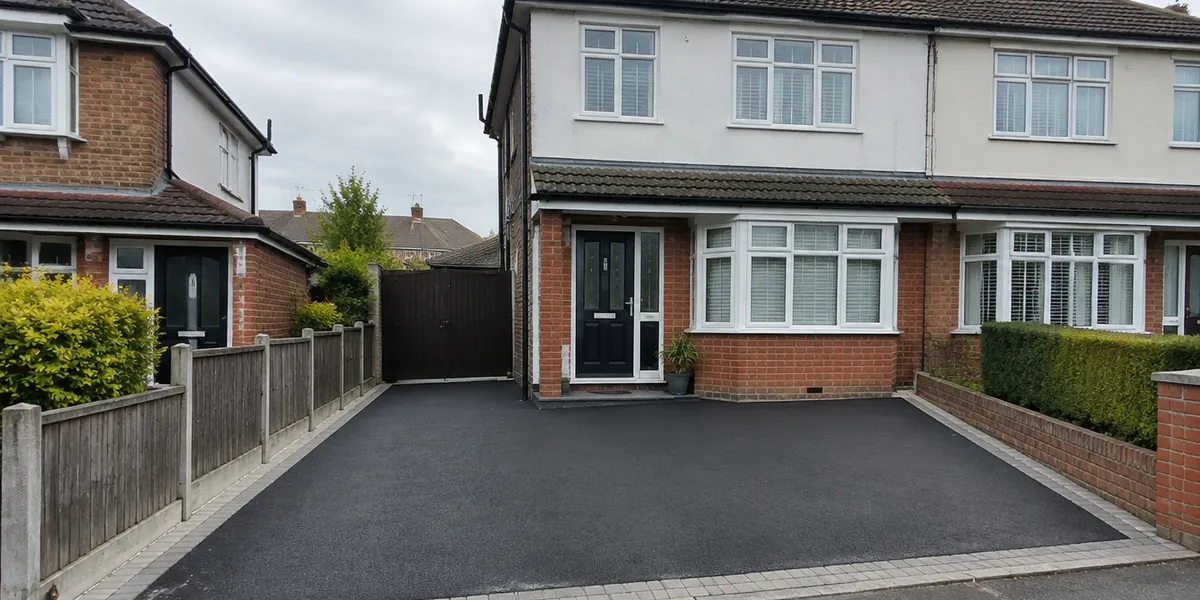
Hot-Rolled Tarmac Driveways
Hot-rolled tarmac is the standard dense bitumen macadam driveway: a black, closed surface laid hot and compacted with a roller while the bitumen is still fluid. It is the right choice for most Glossop homes where the priority is durable, low-maintenance parking at a sensible cost, and it makes up most of our tarmac driveway installation work.
We build it in layers. On top of 150 mm of compacted Type 1 MOT goes a binder course of 20 mm dense bitumen macadam, laid at 50 to 60 mm and rolled. Then a surface course of 6 mm or 10 mm close-graded macadam at 25 to 30 mm, laid while the binder is still warm where possible so the two courses bond. The mix arrives at around 150°C and must be laid and rolled before it drops below roughly 100°C, so we take small loads and keep the roller close behind the rake.
Black is standard, but a red or buff pigmented surface course is available to tie in with brick or stone. Edges are the weak point of any tarmac drive, so we set a concrete kerb, edging block or a course of block paving in concrete haunching before laying and hand-tamp the material against it.
A hot-rolled drive can take a car after 24 to 48 hours, longer in hot weather when the surface stays soft. Keep jack stands and motorbike side stands off it in its first summer, and avoid turning the steering while stationary.
Porous Tarmac Driveways
Porous tarmac, sometimes called open-graded or permeable macadam, is laid with a mix that leaves small voids between the stones so rainwater drains straight through the surface rather than running off it. For a front garden in Glossop this means the drive counts as a permeable surface under the planning rules, so you can usually lay as large an area as you like without a planning application, a soakaway or a channel drain.
The build-up changes below the surface. Instead of Type 1, which is too fine to store water, we use a clean, open-graded crushed stone layer of 20 to 40 mm aggregate, typically 200 to 300 mm deep depending on how freely the ground drains. A geotextile separates this reservoir from the subsoil. The porous surface course is laid at around 40 to 60 mm and compacted with care, because over-rolling closes the voids.
Porous tarmac suits level or gently sloping sites and clay ground where rain would otherwise sit, and it is a sound choice for anyone replacing a surface that floods the pavement. It looks slightly coarser than a dense surface course and needs sweeping and an occasional jet wash to keep the voids clear of silt. It is less tolerant of a heavy van turning on it, so for a working drive we may suggest hot-rolled tarmac with a drain instead. What affects the result most is the depth and cleanliness of the stone reservoir and the gradient beneath it, which we check on the survey in Glossop.
Why Choose Us for Tarmac Driveway Installation in Glossop
Tarmac has a reputation problem, and most of it comes from drives laid by passing gangs with leftover material from a road job. Those drives are typically one thin course laid cold over whatever was there before, with no edge restraint. They look fine for a month. We have dug out plenty of them in Glossop and we build to a different standard.
Our tarmac driveways always have a compacted Type 1 sub-base, a separate binder course and surface course, and edges set in concrete. We source material from a local coating plant on the morning of laying, carry the delivery tickets, and roll with a proper roller rather than a plate compactor. The team that quotes is the team that lays.
You get a fixed, itemised quote in writing before any work starts, a written guarantee afterwards, waste carried away by a registered carrier and straightforward advice on whether tarmac is right for you. On some Glossop properties a resin driveway installation or block paving is the better call, and we will tell you if that is the case.
Our Tarmac Driveway Installation Process
- Site survey. We measure the drive, check falls, look at the existing surface and any drains or manholes, and discuss hot-rolled versus porous for your plot.
- Written quote. An itemised quote sets out the excavation depth, sub-base, courses, edgings and drainage, with a start date agreed once you accept.
- Excavation and disposal. The old surface and soil are removed to around 250 mm below finished level and taken away in skips or by grab lorry.
- Edge restraints. Concrete kerbs, edging blocks or block paving borders are set on a concrete bed with haunching so the tarmac has something solid to compact against.
- Sub-base. Type 1 MOT, or open-graded stone for a porous drive, is laid and compacted in layers, with drainage channels or gullies fitted at this stage.
- Binder and surface course. The hot material is laid from the hot box, raked to level and rolled before it cools, with the second course following on.
- Handover. We clear the site, advise on curing time and hand over the guarantee paperwork.
Most tarmac driveway installation jobs in Glossop are complete within two to four working days, weather permitting, and ready to park on a day or two after that.
Tarmac Driveway Installation in Glossop: What Changes the Price
Size comes first, but what lies under the existing surface comes a close second. A Glossop drive with a sound sub-base already in place needs far less excavation and stone than a front garden being dug out for the first time, and soft or waterlogged ground pushes up the depth of Type 1 required.
The specification of the tarmac itself matters: two full courses cost more than a single overlay, pigmented surface courses cost more than black, and porous tarmac needs a deeper, cleaner stone reservoir underneath. The length of new kerbing or edging blocks, any channel drains or gullies, and whether a dropped kerb needs applying for all add to the figure.
Access plays a part too. A tipper that can back up to the drive makes the job faster than one that has to be barrowed in through a gate. Lastly, disposal of the old surface, especially an old concrete slab that needs breaking out, is a line on its own on the quote.
Tarmac Driveway Installation Across Glossop
We lay tarmac drives all over Glossop. If your home in Hadfield only has room for a tight single-width drive, porous tarmac saves the need for a separate drain. If you have a larger semi or detached home in Charlesworth or Simmondley, a full-width hot-rolled drive with a block paved border lifts the look. If you share a drive with a neighbour in Gamesley, it needs careful level-matching on both sides, and if your home in Padfield came with a thin builder's surface, we replace it with a proper two-course drive. We work across all of these and nearby Stalybridge, Hyde and Ashton-under-Lyne.
Many customers combine this with concrete driveway installation and driveway extensions and widening.
Frequently Asked Questions
How long does a tarmac driveway last?
A two-course tarmac drive on a compacted sub-base with concrete-haunched edges should give many years of service in Glossop with only sweeping and the odd clean. Most failures we see are on drives with a thin single course, no edge restraint or a poor base. Re-surfacing later is also simple, because a sound base can take a new surface course.
Can tarmac be laid over an existing drive?
Sometimes. If the existing tarmac or concrete is sound, level and well-drained, we can plane or clean it and lay a new binder and surface course over the top, which saves excavation. If it is cracked, sunken or sitting on soil, overlaying just copies the faults through, so we recommend digging it out and starting again.
Does a tarmac driveway need planning permission?
Hot-rolled tarmac is impermeable, so a front drive over 5 m² needs rainwater to drain to a lawn, border or soakaway within your boundary, otherwise planning permission is required. Porous tarmac is treated as a permeable surface and avoids the issue. If your property is listed or in a conservation area, additional rules may apply, which we check first.
Why do the edges of some tarmac drives crumble?
Because there is nothing holding them in. Tarmac is a flexible material and needs a solid edge, a concrete kerb, an edging block or a course of block paving set in concrete, to compact against. Without it, the edge compacts poorly, water gets in and tyres break it away. Every drive we lay in Glossop has a restrained edge.
When can I park on a new tarmac driveway?
In mild weather a car can go on after 24 to 48 hours. In hot summer weather the surface stays soft for longer, so give it three or four days and avoid parking in the same spot every day in the first month. Keep motorbike stands, jacks and skips off it during its first summer while the bitumen fully hardens.